Database Support Specialist Academy of Motion Picture Arts and Sciences
 | |
| Abbreviation | AMPAS |
|---|---|
| Germination | May 11, 1927 (1927-05-11) |
| Type | Trade association |
| Tax ID no. | 95-0473280[1] |
| Legal status | 501(c)(half dozen)[2] |
| Purpose | To recognize and uphold excellence in the motion picture show arts and sciences, inspire imagination, and connect the globe through the medium of movement pictures.[2] |
| Headquarters | Beverly Hills, California, U.S. |
| Coordinates | 34°04′02″N 118°23′xiv″Due west / 34.067157°North 118.387347°W / 34.067157; -118.387347 Coordinates: 34°04′02″N 118°23′fourteen″Due west / 34.067157°Due north 118.387347°Due west / 34.067157; -118.387347 |
| Membership | nine,921 (2020)[iii] |
| President | David Rubin (since 2019)[4] |
| Subsidiaries | Academy Museum Foundation 501(c)(3), University Foundation 501(c)(3), Archival Foundation 501(c)(iii), Vine Street Archive Foundation 501(c)(iii) [2] |
| Revenue (2019) | $147,889,867[2] |
| Expenses (2019) | $103,813,370[2] |
| Employees (2018) | 255[ii] |
| Volunteers (2018) | 632[2] |
| Website | www |

The Academy of Motion Picture Arts and Sciences (AMPAS, often pronounced ; also known equally simply the Academy or the Move Picture Academy) is a professional honorary system with the stated goal of advancing the arts and sciences of motion pictures. The University'southward corporate management and general policies are overseen by a board of governors, which includes representatives from each of the craft branches.
As of Apr 2020, the organization was estimated to consist of around nine,921 motility picture professionals. The Academy is an international system and membership is open to qualified filmmakers effectually the earth.
The University is known around the world for its annual Academy Awards, at present officially and popularly known as "The Oscars".[5]
In addition, the Academy holds the Governors Awards annually for lifetime achievement in film; presents Scientific and Technical Awards annually; gives Pupil University Awards annually to filmmakers at the undergraduate and graduate level; awards upward to five Nicholl Fellowships in Screenwriting annually; and operates the Margaret Herrick Library (at the Fairbanks Middle for Moving picture Study) in Beverly Hills, California, and the Pickford Middle for Motion Pic Study in Hollywood, Los Angeles. The University opened the Academy Museum of Motion Pictures in Los Angeles in 2021.[6] [7]
History [edit]

The notion of the University of Motion Picture Arts and Sciences (AMPAS) began with Louis B. Mayer, head of Metro-Goldwyn-Mayer (MGM). He said he wanted to create an system that would mediate labor disputes without unions[eight] and improve the film industry'south paradigm. He met with role player Conrad Nagel, director Fred Niblo, and the head of the Clan of Motility Picture Producers, Fred Beetson to discuss these matters. The idea of this elite club having an annual banquet was discussed, but no mention of awards at that time. They also established that membership into the organization would but be open to people involved in one of the 5 branches of the industry: actors, directors, writers, technicians, and producers.[ix]
Afterward their brief meeting, Mayer gathered up a group of thirty-six people involved in the motion picture industry and invited them to a formal banquet at the Ambassador Hotel in Los Angeles on January eleven, 1927.[10] That evening Mayer presented to those guests what he called the International Academy of Motion Movie Arts and Sciences. Everyone in the room that evening became a founder of the Academy.[nine] Betwixt that evening and when the official Articles of Incorporation for the arrangement were filed on May 4, 1927, the "International" was dropped from the name, becoming the "Academy of Motion Motion-picture show Arts and Sciences".[11] [12]
Several organizational meetings were held prior to the first official coming together held on May 6, 1927. Their showtime organizational coming together was held on May eleven at the Millennium Biltmore Hotel. At that meeting Douglas Fairbanks, Sr. was elected as the first president of the Academy, while Fred Niblo was the first vice-president, and their first roster, equanimous of 230 members, was printed.[11] That dark, the University also bestowed its start honorary membership, to Thomas Edison.[12] Initially, the Academy was broken down into five main groups, or branches, although this number of branches has grown over the years. The original v were: Producers, Actors, Directors, Writers and Technicians.[13]
The initial concerns of the group had to do with labor."[xiv] Withal, every bit fourth dimension went on, the organisation moved "further away from interest in labor-management arbitrations and negotiations."[xv] One of several committees formed in those initial days was for "Awards of Merit," but it was not until May 1928 that the commission began to accept serious discussions well-nigh the construction of the awards and the presentation anniversary. By July 1928, the lath of directors had approved a list of 12 awards to exist presented.[16] During July the voting system for the Awards was established, and the nomination and selection procedure began.[17] This "laurels of merit for distinctive achievement" is what we know at present as the Academy Awards.
The initial location of the arrangement was 6912 Hollywood Boulevard.[xiv] [15] In November 1927, the Academy moved to the Roosevelt Hotel at 7010 Hollywood Boulevard, which was likewise the month the Academy'due south library began compiling a consummate drove of books and periodicals dealing with the industry from around the globe. In May 1928, the Academy authorized the construction of a state of the art screening room, to be located in the Club lounge of the hotel. The screening room was non completed until April 1929.[14]
With the publication of Academy Reports (No. 1): Incandescent Illumination in July 1928,[18] the Academy began a long history of publishing books to assist its members.[19] [20] [21] Research Quango[22] of the Academy of Movement Picture show Arts and Sciences trained Signal Corps officers, during World State of war II,[xv] [23] who afterward won two Oscars, for Seeds of Destiny and Toward Independence.[24] [25]
In 1929, Academy members, in a joint venture with the University of Southern California, created America's first film school to further the fine art and science of moving pictures. The schoolhouse'due south founding faculty included Fairbanks (President of the Academy), D. W. Griffith, William C. deMille, Ernst Lubitsch, Irving Thalberg, and Darryl F. Zanuck.[26]
1930 saw another move, to 7046 Hollywood Boulevard, in order to accommodate the enlarging staff,[15] and by Dec of that year the library was acknowledged as "having ane of the nigh complete collections of information on the pic industry anywhere in existence."[27] They remained at that location until 1935 when further growth caused them to motility one time again. This time, the administrative offices moved to one location, to the Taft Edifice at the corner of Hollywood and Vine, while the library moved to 1455 North Gordon Street.[15]
In 1934, the Academy began publication of the Screen Achievement Records Message, which today is known as the Move Moving-picture show Credits Database. This is a list of film credits up for an University Laurels, also as other films released in Los Angeles County, using enquiry materials from the University's Margaret Herrick Library.[28] Some other publication of the 1930s was the outset annual Academy Players Directory in 1937. The Directory was published by the University until 2006 when it was sold to a private concern. The Academy had been involved in the technical aspects of picture making since its founding in 1927, and past 1938, the Scientific discipline and Technology Council consisted of 36 technical committees addressing technical issues related to sound recording and reproduction, projection, lighting, film preservation, and cinematography.[15]
In 2009, the inaugural Governors Awards were held, at which the Academy awards the Academy Honorary Laurels, the Jean Hersholt Humanitarian Laurels and the Irving Thou. Thalberg Memorial Laurels.
In 2016, the Academy became the target of criticism for its failure to recognize the achievements of minority professionals. For the second twelvemonth in a row, all 20 nominees in the major acting categories were white. The president of the Academy Cheryl Boone Isaacs,[29] the start African American and third woman to lead the Academy,[30] denied in 2015 that at that place was a problem. When asked if the University had difficulty with recognizing diversity, she replied "Not at all. Not at all."[31] When the nominations for acting were all white for a second yr in a row Gil Robertson 4, president of the African American Picture show Critics Association called it "offensive."[ citation needed ] The actors' co-operative is "overwhelmingly white" and the question is raised whether conscious or unconscious racial biases played a office.[32]
Spike Lee, interviewed shortly after the all-white nominee list was published, pointed to Hollywood leadership as the root problem, "We may win an Oscar now and and then, but an Oscar is not going to fundamentally modify how Hollywood does business concern. I'chiliad non talking near Hollywood stars. I'one thousand talking virtually executives. We're non in the room."[33] Boone Isaacs also released a statement, in which she said "I am both heartbroken and frustrated about the lack of inclusion. This is a difficult only important chat, and it'southward time for large changes."[34] After Boone Isaac'south statement, prominent African-Americans such as director Fasten Lee, actors Will Smith and Jada Pinkett Smith, and activist Rev. Al Sharpton chosen for a boycott of the 2016 Oscars for failing to recognize minority achievements, the lath voted to brand "historic" changes to its membership.[ clarification needed ] The Academy stated that by 2020 information technology would double its number of women and minority members.[35] While the University has addressed a higher profile for African-Americans, it has nevertheless to heighten the profile of other people of color artists, in front of and behind the photographic camera.
In 2018, the Academy invited a record 928 new members.[36]
Casting manager David Rubin was elected President of the Academy in Baronial, 2019.[37]
In 2020, Parasite became the first not-English language moving-picture show to win Best Motion picture.[38]
Galleries and theaters [edit]
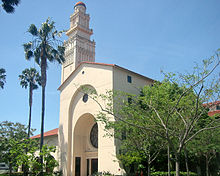
Fairbanks Center for Movement Motion picture Study building on La Cienega Boulevard in Beverly Hills, California

The Academy'due south numerous and diverse operations are housed in iii facilities in the Los Angeles area: the headquarters building in Beverly Hills, which was constructed specifically for the Academy, and two Centers for Motility Picture Study – one in Beverly Hills, the other in Hollywood – which were existing structures restored and transformed to contain the Academy's Library, Film Archive and other departments and programs.
Current [edit]
Academy Headquarters [edit]
The Academy Headquarters Building in Beverly Hills one time housed two galleries that were open up free to the public. The Grand Foyer Gallery and the Fourth Flooring Gallery offered changing exhibits related to films, film-making and flick personalities. These galleries accept since been closed in preparation for the opening of the Academy Museum of Motility Pictures in 2020.
The building includes the Samuel Goldwyn Theater, which seats 1,012, and was designed to present films at maximum technical accurateness, with land-of-the-art projection equipment and sound organization. The theater is decorated year-circular with the Academy's public programming, members-only screenings, picture show premieres and other special activities (including the live television circulate of the University Awards nominations proclamation every January). The edifice in one case housed the Academy Little Theater, a 67-seat screening facility, but this was converted to additional part space in a edifice remodel.
Pickford Eye for Movement Picture Study [edit]
The Pickford Eye for Motion Picture Study, located in cardinal Hollywood and named for legendary actress and Academy founder Mary Pickford, houses several University departments, including the Academy Film Archive, the Science and Technology Quango, Student University Awards and Grants, and the Nicholl Fellowships in Screenwriting. The edifice, originally dedicated on Baronial 18, 1948, is the oldest surviving construction in Hollywood that was designed specifically with idiot box in mind. Additionally, it is the location of the Linwood Dunn Theater, which seats 286 people.
Fairbanks Center for Move Moving-picture show Study [edit]
The Fairbanks Center for Picture Study is located at 333 S. La Cienega Boulevard in Beverly Hills. It is home to the Academy'southward Margaret Herrick Library, a globe-renowned, non-circulating reference and research collection devoted to the history and development of the motility picture as an art form and an manufacture. Established in 1928, the library is open to the public and used year-round by students, scholars, historians and industry professionals. The library is named for Margaret Herrick, the University'southward start librarian who also played a major role in the University'south first televised broadcast, helping to turn the Oscar ceremony into a major annual televised event.[39]
The building itself was built in 1928, where information technology was originally built to be a h2o treatment constitute for Beverly Hills. Its "bell belfry" held h2o-purifying hardware.[forty]
The Academy Museum of Motion Pictures [edit]
The Academy Museum of Motion Pictures, a Los Angeles museum, is the newest facility associated with the Academy. Its scheduled opening was on September xxx, 2021,[41] and it contains over 290,000 square feet (27,000 g2) of galleries, exhibition spaces, movie theaters, educational areas, and special event spaces.[42]
Former [edit]
University Theater in New York [edit]
The Academy also has a New York City-based East Coast showcase theater, the Academy Theater at Lighthouse International. The 220-seat venue was redesigned in 2011 by renowned theater designer Theo Kalomirakis, including an extensive installation of new audio and visual equipment. The theater is in the East 59th Street headquarters of the not-turn a profit vision loss organization, Lighthouse International.[43] In July 2015, it was announced that the Academy was forced to movement out, due to Lighthouse International selling the property the theater was in.[44]
Membership [edit]
Membership in the University is by invitation but. Invitation comes from the Lath of Governors. Membership eligibility may be achieved by earning a competitive Oscar nomination, or by the sponsorship of two electric current Academy members from the same branch to which the candidate seeks admission.[45]
New membership proposals are considered annually in the spring. Press releases announce the names of those who take recently been invited to join. Membership in the University does not elapse, even if a fellow member struggles afterwards in his or her career.[46]
Academy membership is divided into 17 branches, representing different disciplines in motion pictures. Members may not vest to more than one co-operative. Members whose work does non fall within one of the branches may belong to a grouping known every bit "Members at Big". Members at Large have all the privileges of branch membership except for representation on the Board. Acquaintance members are those closely allied to the industry simply not actively engaged in move picture product. They are not represented on the Board and do not vote on University Awards.
Co-ordinate to a February 2012 study conducted past the Los Angeles Times (sampling over 5,000 of its five,765 members), the Academy at that fourth dimension was 94% white, 77% male, 86% age l or older, and had a median age of 62. A tertiary of members were previous winners or nominees of University Awards themselves. Of the Academy'southward 54-fellow member Board of Governors, 25 are female.[47]
On June 29, 2016, a paradigm shift began in the Academy'south selection process, resulting in a new class comprising 46% women and 41% people of colour.[48] The endeavour to diversify the Academy was led by social activist and Broadway Black managing-editor April Reign.[49] Reign created the Twitter hashtag #OscarsSoWhite as a means of criticizing the dearth of non-white nominees for the 2015 Academy Awards. Though the hashtag drew widespread media attending, the Academy remained obstinate on the matter of adopting a resolution that would make demonstrable its efforts to increase diversity. With the 2016 Academy Awards, many, including April Reign, were dismayed by the University'south indifference about representation and inclusion, as the 2016 nominees were one time again entirely white. Apr Reign revived #OscarsSoWhite, and renewed her campaign efforts, which included multiple media appearances and interviews with reputable news outlets. As a issue of Reign's campaign, the discourse surrounding representation and recognition in motion-picture show spread beyond the United States and became a global discussion[ citation needed ]. Faced with mounting pressure to aggrandize the Academy membership, the Academy capitulated and instituted new policies to ensure that time to come Academy membership invitations would ameliorate correspond the demographics of modernistic movie-going audiences.[50] The A2020 initiative was announced in January 2016 to double the number of women and people of colour in membership past 2020[ citation needed ].
Members are able to see many new films for gratuitous at the Samuel Goldwyn Theater and other facilities [ clarification needed ] within two weeks of their debut, and sometimes before release; in add-on, some of the screeners are available through iTunes to its members.[51] [52]
Lists of invitees [edit]
- List of invitees for AMPAS Membership (2004)
- List of invitees for AMPAS Membership (2005)
- List of invitees for AMPAS Membership (2006)
- Listing of invitees for AMPAS Membership (2007)
- List of invitees for AMPAS Membership (2008)
- Listing of invitees for AMPAS Membership (2009)
- List of invitees for AMPAS Membership (2010)
Expulsions [edit]
Five people are known to have been expelled from the Academy. University officials acknowledge that other members have been expelled in the past, most for selling their Oscar tickets, just no numbers are available.[53]
- Actor Carmine Caridi was expelled on February iii, 2004, for copyright infringement. He was accused of leaking screeners that had been sent to him.[54] [55]
- Producer Harvey Weinstein was expelled for "sexually predatory behavior and workplace harassment" subsequently an emergency coming together held on October 13, 2017.[56] [57]
- Actor Bill Cosby and director Roman Polanski were expelled "in accord with the organization's Standards of Behave" on May 1, 2018.[58] Cosby had been convicted of sexual set on one week before, while Polanski had been convicted in 1977 of unlawful sexual intercourse with a minor.
- Cinematographer Adam Kimmel was expelled in 2021 after a Multifariousness story exposed the fact that he is a registered sexual activity offender.[59]
Resignations [edit]
The following members have voluntarily resigned from the organization:
- Audio engineer Tom Fleischman resigned from the Academy on March 5, 2022, citing changes to the broadcast of the 94th Academy Awards ceremony, during which viii award categories – including Best Sound – were not presented alive, simply rather during the commercial breaks.[60] [61] Production sound mixer Peter Kurland besides resigned his membership on March 23, 2022, citing the changes.[62]
- Actor Volition Smith appear his resignation from the Academy on April one, 2022, five days after his onstage slap of Chris Stone, ane of the anniversary'due south presenters, during the 94th Academy Awards.[63]
Academy branches [edit]
The 17 branches of the Academy are:
- Actors
- Casting Directors (created July 31, 2013)[64]
- Cinematographers
- Costume Designers (created from former Art Directors Branch)[65]
- Designers (created from old Fine art Directors Branch)[65]
- Directors
- Documentary
- Executives
- Film Editors
- Make-up Artists and Hairstylists
- Music
- Producers
- Public Relations
- Brusk Films and Characteristic Blitheness
- Sound
- Visual Effects
- Writers
Board of Governors [edit]
As of April 2020[update], the Board of Governors consists of 54 governors: 3 governors from each of the 17 Academy branches and 3 governors-at-large. The Makeup Artists and Hairstylists Branch, created in 2006, had just one governor until July 2013.[65] The Casting Directors Co-operative, created in 2013, elected its offset three governors in Fall 2013.[64] The Board of Governors is responsible for corporate direction, control, and full general policies. The Board of Governors also appoints a CEO and a COO to supervise the administrative activities of the Academy.
Original 36 founders of the Academy [edit]
From the original formal banquet, which was hosted by Louis B. Mayer in 1927, everyone invited became a founder of the University:[66]
Presidents of the University [edit]
Presidents are elected for ane-twelvemonth terms and may not be elected for more than 4 consecutive terms.
| # | Name | Term |
|---|---|---|
| 1 | Douglas Fairbanks | 1927–1929 |
| 2 | William C. DeMille | 1929–1931 |
| iii | M. C. Levee | 1931–1932 |
| 4 | Conrad Nagel | 1932–1933 |
| 5 | J. Theodore Reed | 1933–1934 |
| six | Frank Lloyd | 1934–1935 |
| 7 | Frank Capra | 1935–1939 |
| 8 | Walter Wanger (1st time) | 1939–1941 |
| 9 | Bette Davis | 1941 (resigned after two months) |
| 10 | Walter Wanger (second time) | 1941–1945 |
| 11 | Jean Hersholt | 1945–1949 |
| 12 | Charles Brackett | 1949–1955 |
| 13 | George Seaton | 1955–1958 |
| 14 | George Stevens | 1958–1959 |
| fifteen | B. B. Kahane | 1959–1960 (died) |
| 16 | Valentine Davies | 1960–1961 (died) |
| 17 | Wendell Corey | 1961–1963 |
| xviii | Arthur Freed | 1963–1967 |
| 19 | Gregory Peck | 1967–1970 |
| 20 | Daniel Taradash | 1970–1973 |
| 21 | Walter Mirisch | 1973–1977 |
| 22 | Howard W. Koch | 1977–1979 |
| 23 | Fay Kanin | 1979–1983 |
| 24 | Gene Allen | 1983–1985 |
| 25 | Robert Wise | 1985–1988 |
| 26 | Richard Kahn | 1988–1989 |
| 27 | Karl Malden | 1989–1992 |
| 28 | Robert Rehme (1st time) | 1992–1993 |
| 29 | Arthur Hiller | 1993–1997 |
| xxx | Robert Rehme (2nd time) | 1997–2001 |
| 31 | Frank Pierson | 2001–2005 |
| 32 | Sid Ganis | 2005–2009 |
| 33 | Tom Sherak | 2009–2012 |
| 34 | Militarist Koch | 2012–2013 |
| 35 | Cheryl Boone Isaacs | 2013–2017 |
| 36 | John Bailey | 2017–2019 |
| 37 | David Rubin | 2019–present |
Source: "Academy Story". University of Movement Film Arts and Sciences. Retrieved January 9, 2018.
Electric current assistants of the Academy [edit]
- Academy Officers[67]
- President – David Rubin
- Vice President / Secretary – Donna Gigliotti
- Vice President / Treasurer – David Linde
- Vice President – DeVon Franklin
- Vice President – Larry Karaszewski
- Vice President – Isis Mussenden
- Vice President – Wynn P. Thomas
- Vice President – Jennifer Todd
- Vice President – Janet Yang
- Chief Executive Officer – Dawn Hudson
- Governors[67]
- Actors Branch – Laura Dern, Whoopi Goldberg, Rita Wilson
- Casting Directors Branch – Kim Taylor-Coleman, David Rubin, Debra Zane
- Cinematographers Branch – Paul Cameron, Ellen Kuras, Mandy Walker
- Costume Designers Branch – Ruth East. Carter, Eduardo Castro, Isis Mussenden
- Directors Branch – Susanne Bier, Ava DuVernay, Steven Spielberg
- Documentary Branch – Kate Amend, Jean Tsien, Roger Ross Williams
- Executives Co-operative – Pam Abdy, Donna Gigliotti, David Linde
- Moving picture Editors Co-operative – Dody Dorn, Stephen E. Rivkin, Terilyn A. Shropshire
- Makeup Artists and Hairstylists Branch – Howard Berger, Bill Corso, Linda Flowers
- Marketing and Public Relations Branch – Laura Kim, Christina Kounelias, Nancy Utley
- Music Branch – Lesley Barber, Charles Bernstein, Laura Karpman
- Producers Co-operative – Mark Johnson, Lynette Howell Taylor, Jennifer Todd
- Production Design Branch – Tom Duffield, Jan Pascale, Wynn P. Thomas
- Short Films and Feature Animation Branch – Bonnie Arnold, Jon Bloom, Jennifer Yuh Nelson
- Audio Co-operative – Gary C. Bourgeois, Kevin Collier, Teri E. Dorman
- Visual Furnishings Branch – Craig Barron, Rob Bredow, Brooke Breton
- Writers Branch – Larry Karaszewski, Howard A. Rodman, Eric Roth
- Governors-at-large[29] (nominated by the President and elected by the lath) – DeVon Franklin, Rodrigo García, Janet Yang
See also [edit]
- Academy of Tv set Arts & Sciences
- American Academy of Arts and Sciences
- American Film Institute
- British Academy of Film and Television Arts
- Move Picture show Association of America
- National Pic Registry
References [edit]
- ^ "University Of Motion Picture show Arts And Sciences". Revenue enhancement Exempt Organization Search. Internal Revenue Service. Retrieved March 30, 2022.
- ^ a b c d eastward f k "Grade 990: Return of Arrangement Exempt from Income Revenue enhancement". University of Move Motion picture Arts and Sciences. Internal Revenue Service. June xxx, 2019.
- ^ "A Bail Issue Pulls Back The Curtain At Hollywood's Moving-picture show Academy". Deadline Hollywood. April 21, 2020. Retrieved April 23, 2020.
- ^ "University Story, 2010-2019". University of Motion Motion picture Arts and Sciences. Retrieved March 30, 2022.
- ^ ^ Pond, Steve (February xix, 2013). "AMPAS Drops '85th Academy Awards' – Now It's Simply 'The Oscars'". The Wrap. Retrieved February 22, 2013.
- ^ "Museum". oscars.org. June 15, 2020.
- ^ Cieply, Michael (February 15, 2017). "Delayed Once more, The University Movie Museum Tip-Toes Into 2019". Deadline.com.
- ^ It all started when the original Hollywood mogul wanted to build a beach house David Thomson, Vanity Fair, February 21, 2014
- ^ a b Wiley, Mason, and Damien Bona. Inside Oscar. New York: Ballantine Books, 1986 pg. 2
- ^ Levy, Emanuel. And The Winner Is.... New York: Ungar Publishing, 1987 pg. 1
- ^ a b Osborne, Robert. 60 Years of The Oscar. Abbeville Press, 1989. Page 8.
- ^ a b "History of the Academy: How Information technology Began". Oscars.org. Archived from the original on June v, 2011.
- ^ Osborne, Robert. 60 Years of The Oscar. Abbeville Press, 1989. Folio 9.
- ^ a b c Osborne, Robert. sixty Years of The Oscar. Abbeville Press, 1989. Page 10.
- ^ a b c d e f "History of the University". Oscar.org. Archived from the original on June 5, 2011.
- ^ Osborne, Robert. sixty Years of The Oscar. Abbeville Press, 1989. Page 15.
- ^ Wiley, Mason, and Damien Bona. Inside Oscar. New York: Ballantine Books, 1986 pg. iii
- ^ Academy of Pic Arts and Sciences; American Club of Cinematographers; Association of Picture Producers (July 1928). "Incandescent Illumination". University Reports. Hollywood, CA: Academy of Motility Picture Arts and Sciences. 1 (i). Retrieved May 21, 2021.
Transactions, enquiries, demonstrations, tests, etc., on the bailiwick of incandescent illumination equally applied to motility picture production / conducted past the Academy of Motility Picture Arts and Sciences, in co-operation with American Society of Cinematographers and Association of Motion Motion picture Producers, during the months of Jan, February, March and April, 1928.
- ^ Academy of Motion Picture Arts and Sciences (1931). Cowan, Lester (ed.). Recording Sound for Motion Pictures. New York: McGraw-Colina Book Visitor.
(free) A compilation of lectures on audio sponsored by the Academy of Pic Arts and Sciences, held from September 17, 1929 through December 16, 1929.
- ^ Academy of Move Pic Arts and Sciences Research Council (1938). Movement Picture Sound Engineering. New York: D. Van Nostrand Company, Incorporated.
(free) A Series of Lectures Presented to the Classes Enrolled in the Courses in Sound Engineering Given by the Research Council of the Academy of Motion Flick Arts and Sciences, Hollywood, California, in the fall of 1936 and jump of 1937.
- ^ "Technical Publications". Oscars.org. University of Move Picture show Arts and Sciences. June 23, 2015. Retrieved May 21, 2021.
- ^ Cieply, Michael (March 30, 2020). "If History Asserts Itself, Hollywood And Its Moving picture Academy Volition Rising To The Coronavirus Fight". Deadline . Retrieved May 22, 2021.
The organ through which the Academy mobilized was its Research Council, a collection of production executives chaired by Darryl F. Zanuck. Its main contribution was to offer Washington instant access to the studios' filmmaking apparatus. Zanuck explained in a annotation to the report: "Through the Research Council, the entire vast production facilities and creative talent of the American film industry has been made bachelor to the War Department entirely on a not-turn a profit basis." There were to be no charges for overhead, equipment, stage space or other facilities.
- ^ "Consignment schedule, advanced form in moving-picture show production for Signal Corps officers, Us Ground forces". Academy History Archive. Academy of Motion picture Arts and Sciences. 1940. Retrieved May 21, 2021.
Syllabus for a 39-week course covering all aspects of filmmaking, including equipment operation and maintenance, laboratory work, story development, directing, sound recording and motion-picture show editing; 9 pages.
- ^ Brackett, Charmain Z. (March 8, 2010). "Oscars at home in Signal Museum". army.mil . Retrieved May 21, 2021.
Darryl Zanuck, who headed 20th Century Fox and received the Academy of Motility Picture Arts and Sciences Irving Thalberg Memorial Honor, was a colonel in the Signal Corps during Earth War II. Too in the Signal Corps during World War II was Oscar winning director Frank Capra, and Theodor Seuss Geisel, better known as Dr. Seuss. The efforts of these and others who served in Astoria, Northward.Y. with the 834th Signal Service Photographic Detachment at the Signal Corps Photographic Center produced armed forces training films besides as Academy Award winning documentaries after the war, according to Signal Corps Museum director Robert Anzuoni.
- ^ "Oscar Winners". Ground forces Pictorial Eye. June 10, 2019. Retrieved May 21, 2021.
- ^ Staff. "USC School of Cinematic Arts: History". movie house.usc.edu. Retrieved February 9, 2014.
- ^ Osborne, Robert. 60 Years of The Oscar. Abbeville Press, 1989. Page 12.
- ^ "Motility Picture show Credits Database". Oscars.org. Archived from the original on Oct one, 2014. Retrieved January 18, 2014.
- ^ a b "lath of governors". Academy of Motion Pic Arts and Sciences. February 1, 2016. Retrieved February ane, 2016.
- ^ "Cheryl Boone Isaacs elected beginning African-American head of Oscars". Goldderby.com. July 31, 2013. Retrieved August 2, 2013.
- ^ University Awards President Cheryl Boone Isaacs Responds Afterward 'Oscars So White' Snubs On Twitter Tyler McCarthy, international Business Times, January 17, 2015
- ^ Oscar nominations uproar raises the question: Did racial bias, conscious or not, come into play? The LA Times, Jan 23, 2016
- ^ Another Oscar Twelvemonth, Some other All-White Election Cara B Buckley, The New York Times, January xv, 2016
- ^ Boone, Cheryl; Isaacs (January xviii, 2016). "STATEMENT FROM ACADEMY PRESIDENT CHERYL BOONE ISAACS". Oscars.org. Academy of Motion Motion-picture show Arts and Sciences. Retrieved January 29, 2016.
- ^ University Promises 'Historic' Changes to Diversify Membership Daniel Kreps, RollingStone, Jan 23, 2016
- ^ Kilday, Gregg (June 25, 2018). "Academy Invites Record 928 New Members". The Hollywood Reporter. Archived from the original on August 31, 2021. Retrieved December ix, 2021.
- ^ Oldham, Stuart (August 6, 2019). "David Rubin Elected President of the Motility Picture Academy". Variety . Retrieved August 7, 2019.
- ^ "'Parasite' Earns Best-Motion picture Oscar, Kickoff for a Flick Not in English language". The New York Times. Feb nine, 2020. Retrieved April 23, 2020.
- ^ "About the Library". Oscars.org. AMPAS. July 30, 2014. Retrieved Jan 29, 2016.
- ^ "The Beverly Hills Waterworks Edifice, now known as the Fairbanks Center for Motion Movie Study". Los Angeles Times. Archived from the original on September nine, 2014. Retrieved January 29, 2016.
- ^ "Visit". www.academymuseum.org . Retrieved April 22, 2020.
- ^ The Academy Museum. Oscars.org. Retrieved on May 22, 2014.
- ^ Lester, Ahren. "HARMAN's JBL loudspeakers installed at New York'due south Academy Theater". Audio Pro International. Archived from the original on June 26, 2013. Retrieved Feb xviii, 2012.
- ^ Feinberg, Scott (July x, 2015). "University Forced Out of Longtime Theater Venue in New York". The Hollywood Reporter . Retrieved Jan 29, 2016.
- ^ "Academy Membership". Feb 27, 2017.
- ^ "Oscar voters aren't e'er who you might think". Los Angeles Times. Feb 19, 2012. Retrieved Feb 26, 2012.
- ^ "Lath of Governors". oscars.org. September 2014. Retrieved April 22, 2020.
- ^ "Academy'southward diverse new class includes Idris Elba, America Ferrera". USA Today. June 29, 2016.
- ^ "Encounter April Reign, the Activist Who Created OscarsSoWhite". HuffPost. February 27, 2016.
- ^ "Updates on the film academy's 2016 class: An sectional society gets much bigger later OscarsSoWhite". 50.A. Times. June 29, 2016.
- ^ Hammond, Pete (March 26, 2012). "Oscar Voters Last To Run into 'Hunger Games'?". Deadline Hollywood . Retrieved March 26, 2012.
- ^ "Academy members get screeners through iTunes".
- ^ Day, Patrick (February 27, 2004). "The academy: Neither a secret, nor a society". chicagotribune.com. Chicago Tribune. Retrieved March 31, 2022.
- ^ "The Godfather Actor Cherry Caridi Says He Was Thrown Out of the Academy for Sharing VHS Screeners". PEOPLE.com. February 22, 2017. Retrieved October 15, 2017.
- ^ "An Role player's Personal Tale: I Was Thrown Out of the Academy for Sharing VHS Screeners". The Hollywood Reporter . Retrieved October 15, 2017.
- ^ Barnes, Brooks (October xiv, 2017). "Harvey Weinstein Ousted From Move Picture Academy". The New York Times. ISSN 0362-4331. Retrieved October fifteen, 2017.
- ^ Lartey, Jamiles; London, Edward Helmore David Batty in (October 14, 2017). "Harvey Weinstein expelled from Academy over sexual assail allegations". The Guardian. ISSN 0261-3077. Retrieved Oct xv, 2017.
- ^ "Film Academy Expels Roman Polanski and Bill Cosby". May iii, 2018.
- ^ Aurthur, Kate (March 17, 2021). "Academy Expels Registered Sex Offender Adam Kimmel After Multifariousness Investigation (Exclusive)".
- ^ Giardina, Carolyn (March 5, 2022). "Oscar Winner Tom Fleischman Resigns From Film Academy Over Controversial Telecast Plans (Sectional)". The Hollywood Reporter . Retrieved April 1, 2022.
- ^ Haring, Bruce (March v, 2022). "Oscar-Winning Sound Mixer Tom Fleischman Resigns From AMPAS Over Its Televised Category Plans". Deadline . Retrieved Apr 1, 2022.
- ^ Giardina, Carolyn (March 23, 2022). "Academy Fellow member Peter Kurland to Resign Over Oscars Telecast Controversy (Exclusive)". The Hollywood Reporter . Retrieved April i, 2022.
- ^ Stelter, Brian (April 3, 2022). "Will Smith resigns from the Academy". CNN . Retrieved Apr 5, 2022.
- ^ a b "The Academy Creates Co-operative For Casting Directors". Academy of Motility Picture Arts and Sciences. July 31, 2013. Retrieved August ii, 2013.
- ^ a b c "Oscars shockeroo: Alex Gibney beats incumbent Michael Moore for board seat". Goldderby.com. July fifteen, 2013. Retrieved Baronial 2, 2013.
- ^ "History of the Academy: Original 36 founders of the Academy Actors". Academy of Motion Picture Arts and Sciences website. 2008. Retrieved July 20, 2013.
- ^ a b "Board of Governors". Oscars.org | Academy of Motion Film Arts and Sciences. September i, 2014.
External links [edit]
 Media related to Academy of Motion Picture Arts and Sciences at Wikimedia Eatables
- Official website
- University of Motion Film Arts and Sciences on Twitter
- University of Motion Picture Arts and Sciences'southward aqueduct on YouTube
- Hollywood is a Union Boondocks, The Nation (April two, 1938) History of the Academy and Screen Actors Club
Source: https://en.wikipedia.org/wiki/Academy_of_Motion_Picture_Arts_and_Sciences

Post a Comment for "Database Support Specialist Academy of Motion Picture Arts and Sciences"