Is a Martial Artsdance Created by Runaway Slaves in Brazil
 Capoeira or the Trip the light fantastic of State of war by Johann Moritz Rugendas, 1825, published in 1835 | |
| Focus | Kicking, Striking |
|---|---|
| Country of origin | Brazil |
| Famous practitioners | Mestre Bimba, Mestre Pastinha, Mestre Sinhozinho, Mestre João Grande, Mestre João Pereira dos Santos, Mestre Norival Moreira de Oliveira, Mestra Janja, fr:Mestre Cabeludo, Mestre Caramuru, Mestre Cobra Mansa, Mestre Xuxo, Jairo, Junior dos Santos, Wesley Snipes, Mark Dacascos, Lateef Crowder dos Santos,Cesar Carneiro |
Capoeira (Portuguese pronunciation: [kapuˈe(j)ɾɐ] or [kaˈpwɐjɾɐ]) is a Brazilian martial art that combines elements of dance,[1] [two] [3] acrobatics,[4] and music.[5] [6] [7] It was practiced past enslaved Africans in Brazil[8] at the get-go of the 16th century.[nine] It is known for its acrobatic and circuitous maneuvers, often involving easily on the footing and inverted kicks. It emphasizes flowing movements rather than fixed stances; the ginga, a rocking footstep, is usually the focal point of the technique. The nearly widely accepted origin of the word capoeira comes from the Tupi words ka'a ("forest") paũ ("round"),[x] referring to the areas of low vegetation in the Brazilian interior where avoiding slaves would hide. A practitioner of the art is chosen a capoeirista (Portuguese pronunciation: [kapue(j)ˈɾistɐ]).[11] [12]
The dance and music was incorporated in the arrangement to disguise the fact that they were practicing fighting techniques.[xiii] After the abolition of slavery in Brazil, capoeira was declared illegal at the end of the 19th century. Still, past the 1920s, authorities began to relax enforcement on its prohibition, and martial artists began to incorporate capoeira technique into their practices. By the 1970s, capoeira masters started traveling around the earth, helping the fine art become internationally recognized and practiced. On 26 November 2014, capoeira was granted a special protected status as intangible cultural heritage by UNESCO.[xiv]
History [edit]
During the 16th century, the Portuguese bought, sold, traded, and transported African peoples. Brazil, with its vast territory, received almost 40% of these African people via the Atlantic slave trade. The early history of capoeira is recorded past historians such as Dr. Desch-Obi. Originally, the antecedent tradition originated from the Kingdom of Kongo and was called N'golo/Engolo (known every bit Angola today); a type of ritual dance that used several elements of kicking, headbutting, slap boxing, walking on i's hands, deception, evasion etc. The purpose was also religious equally information technology both provided a link to the afterlife (which was the opposite of the living world) and enabled a person to channel their ancestors into their dance. For example, during the dance, a person might go possessed by an ancestor who was talented at N'golo. This could exist practical to a martial setting in both gainsay and warfare which was called N'singa/ensinga; the difference to N'golo being that it included weapon utilize and grappling. During the Atlantic slave trade, this tradition transferred around the Americas; Brazil (capoeira), the Caribbean (Damnye) and the U.s. (knocking and kick).
Origins [edit]

In the 16th century, Portugal had claimed one of the largest territories of the colonial empires, but lacked people to colonize it, especially workers. In the Brazilian colony, the Portuguese, like many European colonists, chose to utilize slavery to build their economic system.
In its get-go century, the main economic activity in the colony was the product and processing of sugar cane. Portuguese colonists created big sugarcane farms chosen "engenhos", literally "engines" (of economical activeness), which depended on the labor of slaves. Slaves, living in inhumane atmospheric condition, were forced to work difficult and often suffered concrete penalisation for modest misbehaviors.[15]
Although slaves frequently outnumbered colonists, rebellions were rare because of the lack of weapons, harsh colonial law, disagreement betwixt slaves coming from different African cultures, and lack of knowledge about the new land and its surroundings.
Capoeira originated within as a production of the Angolan tradition of "Engolo" only became applied every bit a method of survival that was known to slaves. Information technology was a tool with which an escaped slave, completely unequipped, could survive in the hostile, unknown land and face up the hunt of the capitães-practise-mato, the armed and mounted colonial agents who were charged with finding and capturing escapees.[xvi]
As Brazil became more urbanised in the 17th and 18th centuries, the nature of capoeira stayed largely the aforementioned. However, the nature of the slavery differed from that in the Us. Since many slaves worked in the cities and were most of the time outside the principal'southward supervision, they would exist tasked with finding piece of work to do (in the form of any transmission labour) and in return they would pay the principal a share of the money they made. It is hither where capoeira was mutual as it created opportunities for slaves to practice during and afterward work. Though tolerated until the 1800s, this quickly became criminalised after due to its clan with beingness African, besides as a threat to the current ruling regime. [17]
Quilombos [edit]
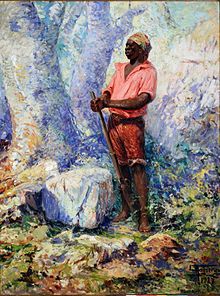
Shortly several groups of enslaved persons who liberated themselves gathered and established settlements, known as quilombos, in remote and difficult-to-accomplish places. Some quilombos would shortly increase in size, attracting more fugitive slaves, Brazilian natives and even Europeans escaping the police force or Christian extremism. Some quilombos would abound to an enormous size, becoming a real independent multi-ethnic state.[eighteen]
Everyday life in a quilombo offered freedom and the opportunity to revive traditional cultures abroad from colonial oppression.[18] In this kind of multi-indigenous community, constantly threatened past Portuguese colonial troops, capoeira evolved from a survival tool to a martial art focused on war.
The biggest quilombo, the Quilombo dos Palmares, consisted of many villages which lasted more than a century, resisting at least 24 small attacks and 18 colonial invasions. Portuguese soldiers sometimes said that information technology took more than than one dragoon to capture a quilombo warrior since they would defend themselves with a strangely moving fighting technique. The provincial governor declared "it is harder to defeat a quilombo than the Dutch invaders."[eighteen]
Urbanization [edit]
In 1808, the prince and hereafter king Dom João Six, along with the Portuguese court, escaped to Brazil from the invasion of Portugal by Napoleon'due south troops. Formerly exploited only for its natural resource and article crops, the colony finally began to develop every bit a nation.[xix] The Portuguese monopoly finer came to an stop when Brazilian ports opened for trade with friendly foreign nations.[xx] Those cities grew in importance and Brazilians got permission to manufacture common products in one case required to exist imported from Portugal, such as drinking glass.[19]
Registries of capoeira practices existed since the 18th century in Rio de Janeiro, Salvador and Recife. Due to metropolis growth, more slaves were brought to cities and the increase in social life in the cities made capoeira more prominent and immune it to be taught and practiced amidst more than people. Because capoeira was oftentimes used against the colonial guard, the colonial government in Rio tried to suppress the martial fine art, and established severe physical punishments to its do, including hunting downwardly practitioners and killing them openly.[21]
Ample data from law records from the 1800s shows that many slaves and free colored people were detained for practicing capoeira:
"From 288 slaves that entered the Calabouço jail during the years 1857 and 1858, 80 (31%) were arrested for capoeira, and simply 28 (ten.7%) for running away. Out of 4,303 arrests in Rio constabulary jail in 1862, 404 detainees—nearly 10%—had been arrested for capoeira."[22]
End of slavery and prohibition of capoeira [edit]

By the cease of the 19th century, slavery was on the verge of departing the Brazilian Empire. Reasons included growing quilombo militia raids in plantations that however used slaves, the refusal of the Brazilian army to bargain with escapees and the growth of Brazilian abolitionist movements. The Empire tried to soften the problems with laws to restrict slavery, only finally Brazil would recognize the end of the establishment on 13 May 1888, with a law chosen Lei Áurea (Golden Law), sanctioned by majestic parliament and signed past Princess Isabel.
Notwithstanding, free former slaves now felt abandoned. Most of them had nowhere to alive, no jobs and were despised past Brazilian club, which usually viewed them equally lazy workers.[23] [24] Also, new immigration from Europe and Asia left nearly former slaves with no employment.[24] [25]
Shortly capoeiristas started to employ their skills in unconventional means. Criminals and war lords used capoeiristas as body guards and assassins. Groups of capoeiristas, known as maltas, raided Rio de Janeiro. The two main maltas were the Nagoas, composed of Africans, and the Guaiamuns, composed of native blacks, people of mixed race, poor whites, and Portuguese immigrants. The Nagoas and Guaiamuns were used, respectively, as a hitforce past the Conservative and Liberal party.[26] In 1890, the recently proclaimed Brazilian Republic decreed the prohibition of capoeira in the whole land.[27] Social conditions were chaotic in the Brazilian capital, and police reports identified capoeira every bit an advantage in fighting.[25]
After the prohibition, any denizen defenseless practicing capoeira, in a fight or for any other reason, would exist arrested, tortured and frequently mutilated by the police force.[28] Cultural practices, such as the roda de capoeira, were conducted in remote places with sentries to warn of approaching police.
Systematization of the art [edit]
By the 1920s, capoeira repression had declined, and some physical educators and martial artists started to incorporate capoeira as either a fighting style or a gymnastic method. Professor Mario Aleixo was the showtime in showing a capoeira "revised, fabricated bigger and improve", which he mixed with judo, wrestling, jogo practice pau and other arts to create what he called "Defesa Pessoal" ("Personal Defense").[1] [29] In 1928, Anibal "Zuma" Burlamaqui published the first capoeira manual, Ginástica nacional, Capoeiragem metodizada e regrada, where he also introduced boxing-like rules for capoeira competition. Information technology was profoundly influential, being even taught at academies.[29] Inezil Penha Marinho published a similar volume.[one] Felix Peligrini founded a capoeira school in the 1920s, intending to exercise it scientifically,[29] while Mestre Sinhozinho from Rio de Janeiro went further in 1930, creating a preparation method that divested capoeira from all its music and traditions in the procedure of making it a complete martial art.[30]
While those efforts helped to go on capoeira alive,[thirty] they also had the effect that the pure, non-adulterated form of capoeira became increasingly rare.[one]
At the same fourth dimension, Mestre Bimba from Salvador, a traditional capoeirista with both legal and illegal fights in his records, met with his future educatee Cisnando Lima, a martial arts aficionado who had trained judo nether Takeo Yano. Both thought traditional capoeira was losing its martial roots due to the use of its playful side to entertain tourists, so Bimba began developing the showtime systematic preparation method for capoeira, and in 1932 founded the kickoff official capoeira school.[31] Advised by Cisnando, Bimba called his style Luta Regional Baiana ("regional fight from Bahia"), considering capoeira was notwithstanding illegal in proper name.[32] At the fourth dimension, capoeira was also known as "capoeiragem", with a practitioner being known as a "capoeira", as reported in local newspapers. Gradually, the art dropped the term to be known as "capoeira" with a practitioner being called a "capoeirista".[33]
In 1937, Bimba founded the school Centro de Cultura Física due east Luta Regional, with permission from Salvador's Secretary of Instruction (Secretaria da Educação, Saúde e Assistência de Salvador). His work was very well received, and he taught capoeira to the cultural aristocracy of the city.[32] By 1940, capoeira finally lost its criminal connotation and was legalized.
Bimba'southward Regional fashion overshadowed traditional capoeiristas, who were nonetheless distrusted past guild. This began to alter in 1941 with the founding of Centro Esportivo de Capoeira Republic of angola (CECA) past Mestre Pastinha. Located in the Salvador neighborhood of Pelourinho, this school attracted many traditional capoeiristas. With CECA's prominence, the traditional style came to exist called Capoeira Angola. The name derived from brincar de republic of angola ("playing Angola"), a term used in the 19th century in some places. Only information technology was likewise adopted past other masters, including some who did not follow Pastinha'due south style.[34]
Though at that place was some caste of tolerance, capoeira from the beginning of the 20th century began to go a more sanitised course of dance with less martial application. This was due to regions mentioned above just likewise due to the military coup in the 1930s to 1945, as well equally the Military government from 1964 to 1985. In both cases, capoeira was still seen by government equally a dangerous pastime which was punishable; however during the Military Authorities it was tolerated as an action for University students (which by this time is the form of capoeira that is recognised today).[ citation needed ]
Today [edit]
Capoeira is an active exporter of Brazilian culture all over the world. In the 1970s, capoeira mestres began to emigrate and teach it in other countries. Present in many countries on every continent, every year capoeira attracts thousands of foreign students and tourists to Brazil. Foreign capoeiristas work hard to learn Portuguese to improve sympathize and get role of the art. Renowned capoeira mestres often teach abroad and establish their ain schools. Capoeira presentations, ordinarily theatrical, acrobatic and with little martiality, are common sights around the world.[14]
In 2014 the Capoeira Circle was added to UNESCO's Representative List of the Intangible Cultural Heritage of Humanity, the convention recognised that the "capoeira circle is a place where knowledge and skills are learned by observation and fake" and that information technology "promotes social integration and the memory of resistance to historical oppression".[14] [35]
Techniques [edit]
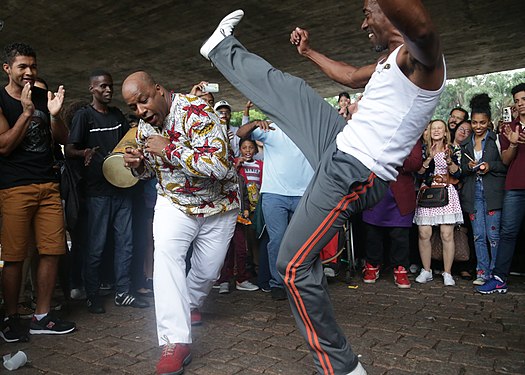
Capoeira is a fast and versatile martial fine art that is historically focused on fighting outnumbered or in technological disadvantage. The manner emphasizes using the lower body to boot, sweep and have down in that location aggressors, using the upper trunk to assistance those movements and occasionally attack as well. It features a serial of complex positions and torso postures that are meant to become chained in an uninterrupted menstruation, to strike, dodge and move without breaking motion, conferring the style with a characteristic unpredictability and versatility.
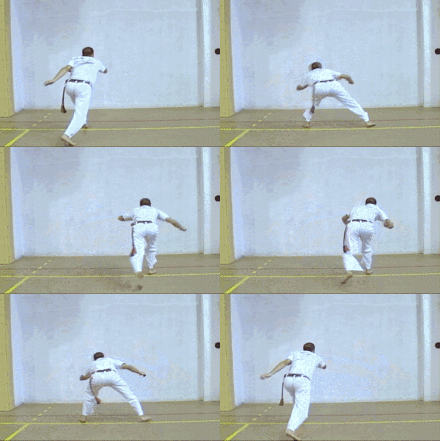
Simple animation depicting role of the ginga
The ginga (literally: rocking back and forth; to swing) is the primal movement in capoeira, of import both for assault and defense purposes. It has two chief objectives. One is to keep the capoeirista in a state of abiding motility, preventing them from beingness a still and easy target. The other, using besides fakes and feints, is to mislead, fool or trick the opponent, leaving them open for an attack or a counter-attack.
The attacks in the capoeira should be washed when opportunity arises, and though they can exist preceded by feints or pokes, they must be precise and decisive, like a direct kick to the head, confront or a vital trunk part, or a stiff takedown. Most capoeira attacks are fabricated with the legs, like direct or swirling kicks, rasteiras (leg sweeps), tesouras or genu strikes. Elbow strikes, punches and other forms of takedowns complete the main list. The head strike is a very important counter-attack move.
The defense is based on the principle of non-resistance, meaning avoiding an attack using evasive moves instead of blocking it. Avoids are called esquivas, which depend on the direction of the attack and intention of the defender, and can be done standing or with a hand leaning on the floor. A block should only be fabricated when the esquiva is completely non-viable. This fighting strategy allows quick and unpredictable counterattacks, the power to focus on more than one adversary and to face up empty-handed an armed adversary.

A capoeira movement (Aú Fechado) (click for animation)
A serial of rolls and acrobatics (like the cartwheels called aú or the transitional position chosen negativa) allows the capoeirista to quickly overcome a takedown or a loss of residue, and to position themselves around the aggressor to lay up for an attack. Information technology is this combination of attacks, defence force and mobility that gives capoeira its perceived "fluidity" and choreography-like manner.
Weapons [edit]
Through virtually of its history in Brazil, capoeira usually featured weapons and weapon preparation, given its street fighting nature. Capoeiristas usually carried knives and bladed weapons with them, and the berimbau could be used to conceal those inside, or even to turn itself into a weapon past attaching a blade to its tip.[29] The knife or razor was used in street rodas and/or against openly hostile opponents, and would exist drawn quickly to stab or slash. Other hiding places for the weapons included hats and umbrellas.[29]
Mestre Bimba included in his teachings a curso de especialização or "specialization course", in which the pupils would exist taught defenses against knives and guns, equally well as the usage of knife, directly razor, scythe, social club, chanfolo (double-edged dagger), facão (facón or machete) and tira-teima (cane sword).[i] Upon graduating, pupils were given a scarlet scarf which marked their specialty. This course was scarcely used, and was ceased after some time. A more common custom practised by Bimba and his students, nonetheless, was furtively handing a weapon to a player before a jogo for them to apply information technology to assail their opponent on Bimba'southward sign, with the other player'southward duty being to disarm them.[i]
This weapon training is almost completely absent in current capoeira teachings, just some groups still exercise the utilise of razors for formalism usage in the rodas.
As a game [edit]

Playing capoeira is both a game and a method of practicing the awarding of capoeira movements in simulated combat. It tin be played anywhere, but it'due south usually done in a roda. During the game almost capoeira moves are used, simply capoeiristas ordinarily avoid using punches or elbow strikes unless it's a very ambitious game.[36]
The game usually does not focus on knocking downward or destroying the opponent, rather it emphasizes skill. Capoeiristas often prefer to rely on a takedown like a rasteira, and then allowing the opponent to recover and get back into the game. It is as well very common to boring down a kick inches before hitting the target, so a capoeirista can enforce superiority without the need of injuring the opponent. If an opponent clearly cannot contrivance an attack, there is no reason to complete it. However, between two loftier-skilled capoeiristas, the game can become much more aggressive and dangerous. Capoeiristas tend to avoid showing this kind of game in presentations or to the general public.[ citation needed ]
Roda [edit]
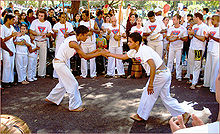
The roda (pronounced [ˈʁodɐ]) is a circumvolve formed by capoeiristas and capoeira musical instruments, where every participant sings the typical songs and claps their hands following the music. Two capoeiristas enter the roda and play the game according to the way required by the musical rhythm. The game finishes when one of the musicians holding a berimbau determine it, when one of the capoeiristas determine to leave or call the stop of the game or when another capoeirista interrupts the game to kickoff playing, either with one of the electric current players or with another capoeirista.[37]
In a roda every cultural aspect of capoeira is nowadays, non only the martial side. Aerial acrobatics are common in a presentation roda, while non seen every bit often in a more than serious one. Takedowns, on the other hand, are common in a serious roda but rarely seen in presentations.[ commendation needed ]
Batizado [edit]
The batizado (lit. baptism) is a formalism roda where new students will get recognized equally capoeiristas and earn their first graduation. Likewise more experienced students may go upwards in rank, depending on their skills and capoeira culture. In Mestre Bimba's Capoeira Regional, batizado was the first time a new student would play capoeira following the sound of the berimbau.[ citation needed ]
Students enter the roda confronting a high-ranked capoeirista (such every bit a teacher or principal) and normally the game ends with the pupil existence taken down. In some cases the more experienced capoeirista can judge the takedown unnecessary. Post-obit the batizado the new graduation, more often than not in the form of a cord, is given.[ citation needed ]
Apelido [edit]
Traditionally, the batizado is the moment when the new practitioner gets or formalizes his or her apelido (nickname). This tradition was created back when capoeira do was considered a crime. To avoid having problems with the constabulary, capoeiristas would nowadays themselves in the capoeira customs but past their nicknames. And then if a capoeirista was captured past the police force, he would be unable to place his boyfriend capoeiristas, even when tortured.[ citation needed ]
Apelidos tin can come up from many different things, such as a physical characteristic (like being tall or large), a habit (like smile or drinking too much), place of birth, a particular skill, an animal, or lilliputian things.[ citation needed ]
Even though apelidos or these nicknames are not necessary whatever more, the tradition is yet very alive not only in capoeira simply in many aspects of Brazilian civilization.[ citation needed ]
Chamada [edit]
Chamada ways 'telephone call' and can happen at any time during a roda where the rhythm angola is being played. It happens when i player, normally the more advanced one, calls his or her opponent to a dance-like ritual. The opponent then approaches the caller and meets him or her to walk next. After information technology both resume normal play.[38]
While information technology may seem similar a break time or a trip the light fantastic toe, the chamada is really both a trap and a test, as the caller is just watching to run across if the opponent will let his guard down so she can perform a takedown or a strike. Information technology is a critical situation, because both players are vulnerable due to the close proximity and potential for a surprise attack. Information technology'due south besides a tool for experienced practitioners and masters of the fine art to test a student'south sensation and demonstrate when the student left herself open to attack.[ citation needed ]
The use of the chamada can result in a highly developed sense of awareness and helps practitioners learn the subtleties of anticipating another person's hidden intentions. The chamada tin can be very simple, consisting solely of the bones elements, or the ritual tin be quite elaborate including a competitive dialogue of trickery, or fifty-fifty theatric embellishments.[ citation needed ]
Volta ao mundo [edit]
Volta ao mundo means effectually the globe.
The volta ao mundo takes place after an commutation of movements has reached a conclusion, or after there has been a disruption in the harmony of the game. In either of these situations, 1 player will begin walking around the perimeter of the circle counter-clockwise, and the other player will join the volta ao mundo in the opposite part of the roda, before returning to the normal game.[39]
Malandragem and mandinga [edit]
Malandragem is a give-and-take that comes from malandro, which means a person who possesses cunning as well as malícia (malice). This, nevertheless, is misleading as the meaning of malícia in capoeira is the capacity to empathise someone'due south intentions. Men who used street smarts to brand a living were called malandros.
In capoeira, malandragem is the ability to quickly understand an opponent'due south aggressive intentions, and during a fight or a game, fool, trick and deceive him.[forty]
Similarly capoeiristas use the concept of mandinga. Mandinga can be translated "magic" or "spell", only in capoeira a mandingueiro is a clever fighter, able to trick the opponent. Mandinga is a tricky and strategic quality of the game, and even a certain esthetic, where the game is expressive and at times theatrical, particularly in the Angola style. The roots of the term mandingueiro would be a person who had the magic power to avoid harm due to protection from the Orixás.[41]
Alternately Mandinga is a way of saying Mandinka (as in the Mandinka Nation) who are known as "musical hunters". Which straight ties into the term "vadiação". Vadiação is the musical wanderer (with flute in hand), traveler, vagabond.[ citation needed ]
Music [edit]
Music is integral to capoeira. It sets the tempo and manner of game that is to be played inside the roda. Typically the music is formed by instruments and singing. Rhythms (toques), controlled past a typical instrument called berimbau, differ from very slow to very fast, depending on the style of the roda.[42]
Instruments [edit]

Capoeira instruments are disposed in a row called bateria. It is traditionally formed past three berimbaus, two pandeiros, 3 atabaques, i agogô and one ganzá, but this format may vary depending on the capoeira group's traditions or the roda style.[ citation needed ]
The berimbau is the leading instrument, determining the tempo and style of the music and game played. Ii low pitch berimbaus (called berra-boi and médio) class the base of operations and a high pitch berimbau (called viola) makes variations and improvisations. The other instruments must follow the berimbau's rhythm, free to vary and improvise a little, depending upon the capoeira group's musical style.[43]
Equally the capoeiristas alter their playing style significantly following the toque of the berimbau, which sets the game's speed, mode and aggressiveness, it is truly the music that drives a capoeira game.[ citation needed ]
Songs [edit]
Many of the songs are sung in a phone call and response format while others are in the form of a narrative. Capoeiristas sing near a broad variety of subjects. Some songs are most history or stories of famous capoeiristas. Other songs attempt to inspire players to play better. Some songs are about what is going on within the roda. Sometimes the songs are nigh life or love lost. Others have lighthearted and playful lyrics.[ citation needed ]
There are iv basic kinds of songs in capoeira, the Ladaínha, Chula, Corrido and Quadra. The Ladaínha is a narrative solo sung only at the commencement of a roda, frequently by a mestre (chief) or most respected capoeirista present. The solo is followed by a louvação, a telephone call and response pattern that usually cheers God and 1's master, among other things. Each call is usually repeated word-for-word by the responders. The Chula is a song where the vocalist part is much bigger than the chorus response, commonly viii singer verses for i chorus response, just the proportion may vary. The Corrido is a song where the singer role and the chorus response are equal, ordinarily 2 verses by 2 responses. Finally, the Quadra is a song where the same verse is repeated four times, either three singer verses followed by i chorus response, or one verse and one response.[ citation needed ]
Capoeira songs tin can talk most virtually anything, being it about a historical fact, a famous capoeirista, niggling life facts, hidden messages for players, annihilation. Improvisation is very important also, while singing a song the master vocalizer can change the music'due south lyrics, telling something that'due south happening in or outside the roda.[ citation needed ]
Styles [edit]
Determining styles in capoeira is difficult, since at that place was never a unity in the original capoeira, or a teaching method before the decade of 1920. Notwithstanding, a sectionalization between two styles and a sub-fashion is widely accustomed.[ citation needed ]
Capoeira Angola [edit]
Capoeira de Republic of angola refers to every capoeira that maintains traditions from before the creation of the regional style.
Existing in many parts of Brazil since colonial times, near notably in the cities of Rio de Janeiro, Salvador and Recife, it's impossible to tell where and when Capoeira Republic of angola began taking its present form. The proper noun Angola starts as early as the showtime of slavery in Brazil, when Africans, taken to Luanda to be shipped to the Americas, were called in Brazil "blackness people from Republic of angola", regardless of their nationality. In some places of Brazil people would refer to capoeira as "playing Angola" and, according to Mestre Noronha, the capoeira school Centro de Capoeira Republic of angola Conceição da Praia, created in Bahia, already used the name Capoeira Angola illegally in the commencement of the 1920 decade.[34]
The proper name Angola was finally immortalized by Mestre Pastinha at 23 February 1941, when he opened the Centro Esportivo de capoeira Angola (CECA). Pastinha preferred the ludic aspects of the game rather than the martial side, and was much respected by recognized capoeira masters. Shortly many other masters would adopt the proper noun Angola, even those who would not follow Pastinha's mode.[ citation needed ]
The platonic of Capoeira Angola is to maintain capoeira every bit shut to its roots equally possible. Characterized by being strategic, with sneaking movements executed continuing or near the floor depending on the state of affairs to face, it values the traditions of malícia, malandragem and unpredictability of the original capoeira.[ citation needed ]
Typical music bateria germination in a roda of Capoeira Republic of angola is three berimbaus, 2 pandeiros, i atabaque, one agogô and one ganzuá.[44]
Capoeira Regional [edit]
Capoeira Regional began to take grade in the 1920s, when Mestre Bimba met his futurity student, José Cisnando Lima. Both believed that capoeira was losing its martial side and concluded there was a need to re-strengthen and structure it. Bimba created his sequências de ensino (pedagogy combinations) and created capoeira's get-go teaching method. Advised by Cisnando, Bimba decided to phone call his mode Luta Regional Baiana, as capoeira was still illegal at that time.[45] [46]
The base of capoeira regional is the original capoeira without many of the aspects that were impractical in a existent fight, with less subterfuge and more objectivity. Training focuses mainly on attack, dodging and counter-attack, giving high importance to precision and discipline. Bimba as well added a few moves from other arts, notably the batuque, an old street fight game invented by his male parent.[47] Use of jumps or aeriform acrobatics stay to a minimum, since one of its foundations is always keeping at least ane mitt or foot firmly attached to the ground. Mestre Bimba often said, "o chão é amigo do capoeirista" (the floor is a friend to the capoeirista).[ citation needed ]
Capoeira Regional also introduced the first ranking method in capoeira. Regional had three levels: calouro (freshman), formado (graduated) and formado especializado (specialist). After 1964, when a student completed a course, a special commemoration ceremony occurred, ending with the teacher tying a silk scarf effectually the capoeirista's neck.[48]
The traditions of roda and capoeira game were kept, being used to put into utilize what was learned during training. The disposition of musical instruments, notwithstanding, was changed, existence made by a single berimbau and two pandeiros.[ citation needed ]
The Luta Regional Baiana before long became popular, finally irresolute capoeira's bad image. Mestre Bimba made many presentations of his new mode, but the best known was the one made at 1953 to Brazilian president Getúlio Vargas, where the president would say: "A Capoeira é o único esporte verdadeiramente nacional" (Capoeira is the only truly national sport).[49]
Capoeira Contemporânea [edit]
In the 1970s a mixed style began to take form, with practitioners taking the aspects they considered more than important from both Regional and Angola. Notably more acrobatic, this sub-manner is seen by some every bit the natural evolution of capoeira, by others every bit cariosity or fifty-fifty misinterpretation of capoeira.[ commendation needed ]
Nowadays the label Contemporânea applies to any capoeira group who don't follow Regional or Angola styles, even the ones who mix capoeira with other martial arts. Some notable groups whose style cannot be described as either Angola or Regional but rather "a fashion of their own", include Senzala de Santos, Cordão de Ouro and Abada. In the case of Cordão de Ouro, the style may be described as "Miudinho", a depression and fast-paced game, while in Senzala de Santos the way may described simply as "Senzala de Santos", an elegant, playful combination of Angola and Regional. Capoeira Abada may be described equally a more aggressive, less dance-influenced style of capoeira.[ commendation needed ]
Ranks [edit]
Because of its origin, capoeira never had unity or a general understanding. Ranking or graduating system follows the same path, equally there never existed a ranking system accepted past about of the masters. That means graduation style varies depending on the group's traditions.
The most common modern system uses colored ropes, called corda or cordão, tied around the waist. Some masters use different systems, or even no system at all.[50]
There are many entities (leagues, federations and association) that have tried to unify the graduation system. The most usual[ commendation needed ] is the organization of the Confederação Brasileira de Capoeira (Brazilian Capoeira Confederation), which adopts ropes using the colors of the Brazilian flag, green, xanthous, blueish and white.[ citation needed ]
Even though it is widely used with many small variations, many large and influential groups however use different systems, in example, Porto da Barra Group that uses belts that tell the Brazilian slavery history. Even the Confederação Brasileira de Capoeira is not widely accepted equally the capoeira's main representative.[ citation needed ]
In a substantial number of groups (mainly of the Angola school) at that place is no visible ranking system. At that place tin still be several ranks: student, treinel, professor, contra-mestre and mestre, simply often no cordas (belts).[51]
[edit]
Even though those activities are strongly associated with capoeira, they accept different meanings and origins.
Samba de roda [edit]
Performed past many capoeira groups, samba de roda is a traditional Brazilian trip the light fantastic and musical form that has been associated with capoeira for many decades. The orchestra is composed by pandeiro, atabaque, berimbau-viola (loftier pitch berimbau), chocalho, accompanied past singing and clapping. Samba de roda is considered i of the archaic forms of modern Samba.
Maculelê [edit]
Originally the Maculelê is believed to have been an indigenous armed fighting manner, using two sticks or a machete. Present it'south a folkloric dance practiced with heavy Brazilian percussion. Many capoeira groups include Maculelê in their presentations.
Puxada de rede [edit]
Puxada de Rede is a Brazilian folkloric theatrical play, seen in many capoeira performances. Information technology is based on a traditional Brazilian legend involving the loss of a fisherman in a seafaring accident.
Sports development [edit]
Capoeira is currently existence used every bit a tool in sports development (the utilize of sport to create positive social alter) to promote psychosocial wellbeing in diverse youth projects around the world. Capoeira4Refugees is a UK-based NGO working with youth in conflict zones in the Middle East. Capoeira for Peace is a project based in the Democratic Commonwealth of Congo. The Nukanti Foundation works with street children in Colombia. Capoeira Maculelê has social projects promoting cultural arts for wellness in Colombia, Angola, Brazil, Argentina, Usa amidst others.
MMA [edit]
Many Brazilian mixed martial arts fighters have a capoeira background, either training ofttimes or having tried it before. Some of them include Anderson Silva, who is a yellow belt, trained in capoeira at a young age, then again when he was a UFC fighter; Thiago Santos, an agile UFC middleweight contender who trained in capoeira for viii years; Former UFC Heavyweight Champion Júnior dos Santos, who trained in capoeira as a child and incorporates its boot techniques and movement into his stand up up; Marcus "Lelo" Aurélio, who is famous for knocking a fighter out with a Meia-lua de Compasso kick, and UFC veterans José Aldo and Andre Gusmão as well use capoeira as their base of operations.
See also [edit]
- Juego de maní
- Capoeira in pop culture
- Engolo
References [edit]
- ^ a b c d e f Capoeira, Nestor (2012). Capoeira: Roots of the Dance-Fight-Game. Due north Atlantic Books. ISBN978-ane-58394-637-iv.
- ^ Ancona, George (2007). Capoeira: Game! Trip the light fantastic toe! Martial Fine art!. Lee & Low Books. ISBN978-1-58430-268-1.
- ^ Goggerly, Liz (2011). Capoeira: Fusing Dance and Martial Arts. Lerner Publications. ISBN978-0-7613-7766-five.
- ^ Poncianinho, Mestre; Almeida, Ponciano (2007). Capoeira: The Essential Guide to Mastering the Art. New The netherlands. ISBN978-1-84537-761-viii.
- ^ Dils, Ann; Cooper Albright, Ann (2001). Moving History/Dancing Cultures: A Dance History Reader. Wesleyan Academy Press. p. 165. ISBN978-0-8195-6413-9.
- ^ Cachorro, Ricardo (2012). Unknown Capoeira: A History of the Brazilian Martial Art. Vol. 2. Blueish Snake Books. ISBN978-1-58394-234-5.
- ^ "Capoeira Trip the light fantastic-Like MARTIAL ART". www.britannica.com.
- ^ "Estado é exaltado em festa nacional" (in Brazilian Portuguese). Ministério da Cultura. Archived from the original on 17 November 2018. Retrieved 17 November 2018.
- ^ Assunção 2005, pp. 5–27.
- ^ "Definition of CAPOEIRA". merriam-webster.com . Retrieved 29 May 2019.
- ^ "Hoje é Dia practise Capoeirista" (in Brazilian Portuguese). Ministério da Cultura do Govermo do Brasil. Archived from the original on 17 Nov 2018. Retrieved 17 November 2018.
- ^ "Como surgiu a capoeira?" (in Brazilian Portuguese). Revista Mundo Estranho. Retrieved 17 November 2018.
- ^ All you lot demand to know about: Capoeira www.theguardian.com
- ^ a b c "Brazil'southward capoeira gets Unesco status". BBC News. 26 November 2014. Retrieved 23 September 2019.
- ^ "O Brasil no quadro do Antigo Sistema Colonial" (in Portuguese). Culturabrasil.pro.br. Archived from the original on 18 May 2013. Retrieved 18 Nov 2013.
- ^ "Capoeira History". Capoeira Heart Manchester.
- ^ Desch-Obi, T. J. "Capoeira." Encyclopedia of African-American Civilisation and History, edited by Colin A. Palmer, 2nd ed., vol. 2, Macmillan Reference Us, 2006, pp. 395-398. Gale eBooks, link.gale.com/apps/doc/CX3444700236/GVRL?u=tamp44898&sid=GVRL&xid=fe4652ba. Accessed 19 Jan. 2021.
- ^ a b c Gomes, Flávio (2010). Mocambos de Palmares; histórias east fontes (séculos XVI–XIX) (in Portuguese). Editora 7 Letras. ISBN978-85-7577-641-4.
- ^ a b Gomes, Laurentino (2007). 1808; Como uma rainha louca, um príncipe medroso e uma corte corrupta enganaram Napoleão e mudaram a História de Portugal due east do Brasil (in Portuguese). Editora Planeta. ISBN978-85-7665-320-ii.
- ^ Vimmar Comunicação Digital. "Abertura Dos Portos Às Nações Amigas – 1808". Historiadobrasil.net. Retrieved eighteen Nov 2013.
- ^ "Gangues do Rio: Capoeira era reprimida no Brasil" (in Portuguese). Guiadoestudante.abril.com.br. Archived from the original on 24 October 2012. Retrieved eighteen November 2013.
- ^ Assunção 2005
- ^ Empty webpage at www.brasil.gov.br/sobre/historia/abolicao (archived copy) [ dead link ]
- ^ a b Cardoso, Fernando Henrique (1962). Capitalismo eastward Escravidão no Brasil Meridional (in Portuguese). Editora Civilização Brasileira. ISBN978-85-200-0635-one.
- ^ a b Campos, Andrelino (2005). Practise Quilombo à Favela: A Produção practice "Espaço Criminalizado" no Rio de Janeiro (in Portuguese). Editora Bertrand Brasil. ISBN978-85-286-1159-5.
- ^ a-capoeira-na-politica-as-maltaswww.vermelho.org.br Archived 12 February 2018 at the Wayback Machine
- ^ "Código penal brasileiro – proibição da capoeira – 1890 – Wikisource" (in Portuguese). Pt.wikisource.org. Retrieved eighteen Nov 2013.
- ^ Assuncao, Matthias Rohrig; Assunção, Matthias Röhrig (2005). Capoeira: A History of an Brazilian Martial Art. Psychology Press. ISBN978-0-7146-5031-nine.
- ^ a b c d east Gerard Taylor, Capoeira: The Jogo de Republic of angola from Luanda to Net, vol. 2 (Berkeley CA: Blue Serpent Books, 2007), ISBN 1583941835, 9781583941836
- ^ a b André Luiz Lacé Lopes (2015). A capoeiragem no Rio de Janeiro, primeiro ensaio: Sinhozinho e Rudolf Hermanny. Editorial Europa. ISBN978-85-900795-2-1.
- ^ Kingsford-Smith, Andrew. "Disguised In Trip the light fantastic toe: The Clandestine History Of Capoeira". Culture Trip . Retrieved 3 Oct 2017.
- ^ a b Sodre, Muniz (2002). Mestre Bimba: Corpo de Mandiga (in Portuguese). Livraria da Travessa. ISBN978-85-86218-13-2.
- ^ Roberto Pedreira, Choque: The Untold Story of Jiu-Jitsu in Brazil 1856–1949
- ^ a b "O ABC da Capoeira Republic of angola – Os Manuscritos de Mestre Noronha | Publicaçþes due east Artigos – Capoeira". Portalcapoeira.com. Archived from the original on 20 July 2013. Retrieved xviii Nov 2013.
- ^ "UNESCO – Capoeira circumvolve". Convention for the Safeguarding of the Intangible Cultural Heritage. 2014.
- ^ Crocitti, John J. Vallance, Monique M. (2012). Brazil today : an encyclopedia of life in the republic. Calif. ISBN978-0-313-34672-9. OCLC 810633190.
{{cite book}}: CS1 maint: multiple names: authors listing (link) - ^ DOWNING, BEN (1996). "Jôgo Bonito: A Brief Beefcake of Capoeira". Southwest Review. 81 (4): 545–562. ISSN 0038-4712. JSTOR 43471791.
- ^ "Capoeira – The Martial Arts Encyclopedia". bullshido.org. Archived from the original on 10 April 2018. Retrieved nine April 2018.
- ^ Neto, Vianna. "Capoeira and Transnational Culture" (PDF). Griffith University. Vianna Neto & Eurico Lopez Baretto. Retrieved 14 Jan 2021.
- ^ Diaz, J. D. (2017). Between repetition and variation: A musical performance of malícia in capoeira. Ethnomusicology Forum, 26(one), 46–68. doi:x.1080/17411912.2017.1309297
- ^ "O Fio Da Navalha", ESPN Brasil documentary, 2007
- ^ "The History of Capoeira". Capoeira Brasil. Archived from the original on vii March 2018. Retrieved 7 March 2018.
- ^ Assunção, Chiliad. R. (2002). Workers, vagrants, and tough guys in Bahia, c. 1860-1950. In Capoeira: The history of an Afro-Brazilian martial art (pp. 93-124). Taylor & Francis Group.
- ^ "What musical instruments are used in capoeira? | Capoeira Connexion". capoeira-connection.com . Retrieved 9 June 2018.
- ^ Matthias Röhrig Assunção, Capoeira: A History of an Brazilian Martial Art (London: Psychology/Routledge, 2005), 133–35. ISBN 0714650315, 9780714650319; Aniefre Essien, Capoeira Beyond Brazil: From a Slave Tradition to an International Way of Life (Berkeley CA: Blue Snake Books, 2008), 6–8. ISBN 1583942556, 9781583942550
- ^ Taylor, Pp. 233–35.
- ^ "I challenged all the tough guys" – Mestre Bimba, 1973 Archived 3 March 2016 at the Wayback Machine capoeira-connexion.com
- ^ Taylor, Page 234.
- ^ Campos, Hellio (2009), "Capoeira Regional", Capoeira Regional: A escola de Mestre Bimba, EDUFBA, pp. 62–69, doi:10.7476/9788523217273.0007, ISBN9788523217273
- ^ "Capoeira Ranking- Capoeira Cord Organisation". Capoeira-World.com. 2015. Archived from the original on 28 May 2019. Retrieved 29 May 2019.
- ^ https://www.usnews.com/didactics/all-time-high-schools/indiana/districts/m-s-d-steuben-county/angola-high-school-7422[ bare URL ]
Bibliography [edit]
- Assunção, Matthias Röhrig (2005). Capoeira: The History of an Brazilian Martial Art. Routledge. ISBN978-0-7146-8086-vi.
- Capoeira, Nestor (2003). The Piffling Capoeira Volume. Translated by Ladd, Alex. North Atlantic. ISBN978-1-55643-440-ii.
- Talmon-Chvaicer, Maya (2007). The Hidden History of Capoeira: A Standoff of Cultures in the Brazilian Battle Dance . Academy of Texas Press. ISBN978-0-292-71723-vii.
Farther reading [edit]
- Almeida, Bira "Mestre Acordeon" (1986). Capoeira: A Brazilian Art Course . Berkeley: Due north Atlantic Books. ISBN978-0-938190-xxx-1.
- Downey, Greg (2005). Learning Capoeira: Lessons in cunning from an Brazilian art. Oxford Academy Printing. ISBN978-0195176988.
- Mason, Paul H. (2013). "Intracultural and Intercultural Dynamics of Capoeira" (PDF). Global Ethnographic. 1: 1–8.
- Merrell, Floyd (2005). Capoeira and Candomblé: Conformity and Resistance in Brazil. Princeton: Markus Wiener. ISBN978-1-55876-349-4.
- Stephens, Neil; Delamont, Sara (2006). "Balancing the Berimbau Embodied Ethnographic Understanding". Qualitative Inquiry. 12 (ii): 316–339. doi:10.1177/1077800405284370. S2CID 143105472.
External links [edit]
VIDEO CAPOEIRA BRAZILIAN MARTIAL ARTS IN ITACARE, BAHIA
 | Wikimedia Commons has media related to Capoeira. |
 | Await upwards capoeira in Wiktionary, the free dictionary. |
Source: https://en.wikipedia.org/wiki/Capoeira

Post a Comment for "Is a Martial Artsdance Created by Runaway Slaves in Brazil"